Beurre Blanc

Perfecting sauces often proves to be one of the more difficult tasks budding cooks face, but if they can master sauces then they can often transform nice meals into flavoursome feasts fit for lords and ladies, the sauce spearheading the delicious attack on sensory receptors.

Now that we’ve acknowledged this hurdle, let’s have a go at the beurre blanc, one of the simplest sauces. This is particularly useful as it provides easy, essential practice in creating a wine reduction and emulsification – two very important saucy techniques.

Ingredients: (serves 4)

2 shallots, finely chopped
25 cl white wine (traditionally Muscadet)
100-120g unsalted butter
1 tbsp double cream
juice of 1 lemon
salt and pepper
A handful of tarragon or dill, chopped (optional)

Preparation & Cooking:

Start by creating the white wine reduction. To do this, add your wine, shallots, lemon juice and three quarters of your chopped herb – saving the rest for the later – to the saucepan before putting it on a high heat. Allow the liquid to boil off, until there are about two tablespoons of liquid remaining, this is called ‘reducing’ and is a fundamental technique of saucery. Get good at it!

At this stage there is a personal choice to be made. Traditionally, the wine reduction is strained or poured through a sieve to remove the shallots, this is isn’t entirely necessary but a smooth beurre blanc is much nicer, in my opinion.

Add the cream, return the liquid to a boil and then reduce to a low heat. Next, begin to add the butter, whisking in one cube at a time. After the first couple of cubes have been added, you can take the pan off the heat, occasionally returning if the butter struggles to melt. Continue whisking the sauce until it emulsifies. It should thicken nicely, lifting the whisk from the sauce should trace out pale trails on the surface (coming soon: a photo of this). If this is not the case, and the sauce remains too runny, add a little more butter.

Add any chopped herbs that you might have, particularly if you have strained the sauce, even if just for presentation purposes –  a small amount of colour goes a long way. Dill is particularly effective when serving the sauce with fish (Trevor Trout). Finally, season with salt and pepper to taste.

*********************************************************************************************************************
Technicalities:

Emulsion is the term used to describe the result of mixing two substances that don’t mix under normal circumstances. In this case, the emulsion is the butter and wine reduction mixture. Emulsification is aided by what is called an emulsifying agent or emulsifier, these are substances that are rammed full of protein molecules that prevent molecules of either ingredient coupling together. Egg yolk and mustard are two of the most widely used emulsifiers. In the beurre blanc, however, the milk content of the butter proves sufficient and no additional emulsifier is necessary.
*********************************************************************************************************************

Trevor Trout’s Gills of Gluttony

Me and my mate Trev

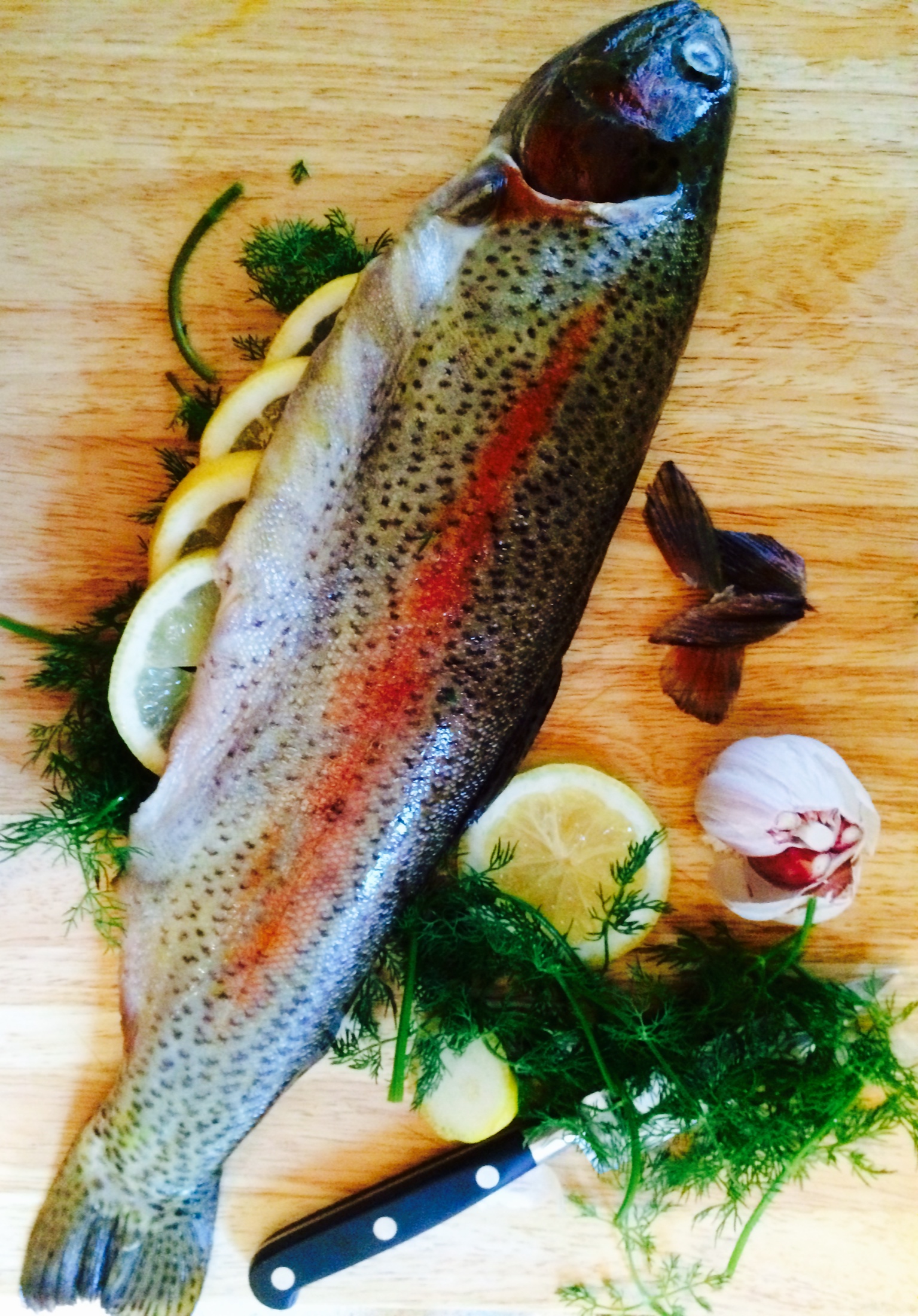
This is a treat and a half, and taking less than an hour to go from fridge to table it’s the perfect lazy man’s dinner. If you’ve been following my posts precisely as closely as you ought to have been, you will remember from The Ovine Oculus that I was particularly taken with Pierre Koffmann’s salted sea bass recipe from The Times Magazine. Yesterday, my grandparents gave me a fresh rainbow trout, Trevor or Trev for short, which they had been given by a family friend. Tipping the scales at 2 lb, Trev was something of a small, country stream leviathan.  Feeling ever greedy, not content with the salty serving (Hank’s hock) we had the day before last and wanting to make use of Trev at his freshest, I decided to get salty and prepare him tonight. If you want to be extra fresh, you could fish your own trout and have all the fun of gutting, or you could just let your fishmonger fishmong.

Obviously, you don’t eat the salt so why spend several pounds on salt that you won’t be eating? The salt casing acts as a small oven that serves to trap in the delicious juices. Ideally, the scales are left on so that they compound the moisture trapping effect, it’s not the end of the world if they’ve been removed though, just make sure your salt casing is extra dense. The skin of a fish is my favourite bit, so I’ve gone against the ‘pro-tip’ by proceeding scaleless. I wouldn’t recommend eating scales, you’re not Action Man.

Stuffed to the gills.

Ingredients:

1 fat trout, gutted
lots of dill
2 garlic cloves, peeled and sliced
1 lemon, sliced
1kg sea salt
Tbsp. fennel seeds
1 egg white
2 bay leaves
1 dozen whole peppercorns
1 beurre blanc sauce

Preparation & Cooking:

Preheat oven to 200°C and give your fish a rinse, inside and out, with some cold water. Stuff the cavity of the fish with the garlic, peppercorns, dill sprigs and lemon slices. Don’t forget to snip off any fins that haven’t already been removed.

Grind up fennel seeds in a pestle and mortar and, in a large bowl, mix together with the egg white and salt until it looks like cloudy glass. Spread some of the salt mixture on a baking tray, put bay leaves on the salt bed and place the prepared fish on top of that. Pack the rest of your salt mixture over the body, leaving the head and tail poking out for presentation. The casing should be evenly spread and approximately a centimetre thick.

Slide your tray into the oven for 20-30 minutes, depending on the size of your fish. I usually gauge 10 minutes per inch thickness of the fish, though this is just a rough rule of thumb. To fine tune cooking time, remove the fish after 20 minutes, slip a knife through the salt and into the thickest part of the fish. If the knife is hot to touch to your lips, then the fish is done.

Awwwh, yeahhh

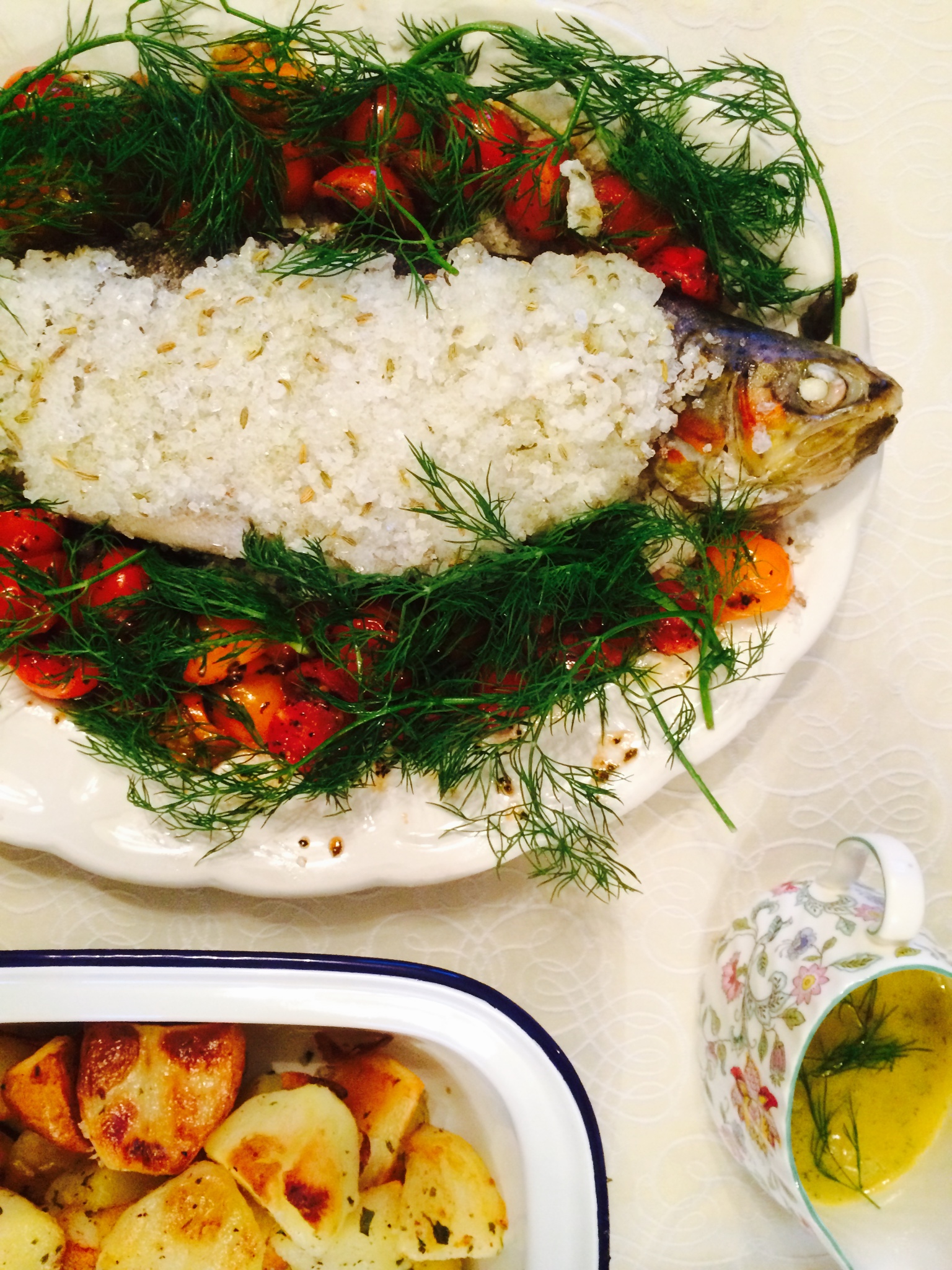
Pan fried tomatoes and some dill ensure that Trev is presented well.

Transfer your fish onto a dill covered plate to serve with sides and sauce of your choosing. I love to have fish with cherry tomatoes that have been pan fried with lots of basil, and a beurre blanc – a rich, white wine (usually a Muscadet, a produce of Loire Valley, France) butter sauce – that has been riddled with lemon and fresh dill. My sauce was made using Muscadet, Domaine de la Quilla, 2012, and obviously the rest of it was drank.

Use the back of the spoon to crack the salty casing around the fish, and lift up the lid of your treasure chest to reveal your fishy gold. The fish will now need filleting. To get the top fillet off, cut across the fish just below the gills and again just above the tail, run the knife along the spine and gently lift the top fillet off. Now grab the tail and gently pull the spine away from the bottom fillet, using a knife to help you work your away along the length of the fish, until the head peels away too, leaving the fillet on the plate. The single piece of fishy waste can be discarded or kept for fish stock. You now have two succulent, salt baked fillets that are ready to eat. Don’t be disheartened if this feels like hard work, it’s fiddly and takes practice, but lots of fun once you’re good at it!

La fin.